the ever so awesome Pieces of Eight gallery is in full swing after opening it doors in December last year...the lovely ladies pick a Piece of the Day every day and selected one of my pomander inspired pieces last week..sweet.
Sabtu, 26 Februari 2011
Rabu, 01 Desember 2010
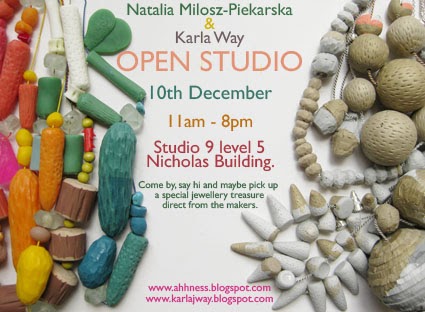
End of Year Open Studio!
Its almost time to put down our tools, step away from the bench and take a little break...almost time...until then, we will be working like crazy!
Natalia and I will be opening the studio door (whilst working like crazy)for you to pop in and say hello, and perhaps pick up a treasure for someone special, or your special self...
Jumat, 01 Oktober 2010
Strand by Strand: Emotional Engagement at the Museum of the Earth
This is the first in a series of posts inspired by the National Research Council report Learning Science in Informal Environments: People Places and Pursuits. The report outlines Six Strands of informal science learning. Each of my posts will focus on a museum exhibit that exemplifies one of these Strands. This post also appears as a review on ExhibitFiles.
Strand One: Developing Interest in Science

"... personal interest and enthusiasm are important for supporting children's participation in learning science." (Learning Science, 43)


It came as no surprise to learn from one of the scientists volunteering at the table that day that this experience is incredibly labor intensive to maintain and staff. They have to pore over most of the shale before it goes out on the table to ensure good fossil content and the table must be staffed at all times. On my rainy Saturday visit there were no staff members on the floor except for in that corner. The museum realized they had a successful, popular activity and made it their priority. At other museums, these kinds of facilitated experiences are often overlooked or ruled out for lack of resources, but even a small museum like the Museum of the Earth can maintain a docent station like the Fossil Lab if they decide it's important enough.
Judging from the squeals of excitement coming from the Fossil Lab, I’d say the Museum of the Earth made an excellent call. There’s no doubt in my mind that the children I watched will be talking about their discoveries and showing off their souvenir fossils for years to come. The highly emotional experience of discovering something for yourself not only builds strong memories, it gives you a sense of ownership and personal connection to what you're learning about. And it's through those connections that you start developing the interest in science that provides the foundation for science learning.
If you're not interested in science, chances are you won't want to learn about it. And that's why Developing an Interest in Science is the first Strand in the NRC report. One of the best ways to foster an interest in science is through personal discovery. The feeling of discovery is very emotional and memorable and it helps to build deep, personal connections. Learning Science refers to this as "emotional engagement". The Museum of the Earth of Ithaca, New York knows the power of emotional engagement and invites visitors to make their own personal discoveries in their Fossil Lab.
The Fossil Lab is a facilitated table in the corner of Beneath an Ancient Sea, a gallery in the permanent exhibit Journey Through Time. There, volunteers call visitors over to a series of bins overflowing with locally found fossil-rich shale.
“If you find a fossil, you can keep it,” they say.
I can’t think of a more enticing proposition. On my recent visit to the museum I watched two kids, maybe 5 and 7, sit at this table for a good half hour, jumping up with excitement whenever they found a trilobite or a brachiopod and proudly showing their finds to their mother. The volunteer scientists behind the counter helped them identify their fossils, but of course the real prize was the thrill of discovery and taking home a special treasure.
It came as no surprise to learn from one of the scientists volunteering at the table that day that this experience is incredibly labor intensive to maintain and staff. They have to pore over most of the shale before it goes out on the table to ensure good fossil content and the table must be staffed at all times. On my rainy Saturday visit there were no staff members on the floor except for in that corner. The museum realized they had a successful, popular activity and made it their priority. At other museums, these kinds of facilitated experiences are often overlooked or ruled out for lack of resources, but even a small museum like the Museum of the Earth can maintain a docent station like the Fossil Lab if they decide it's important enough.
Judging from the squeals of excitement coming from the Fossil Lab, I’d say the Museum of the Earth made an excellent call. There’s no doubt in my mind that the children I watched will be talking about their discoveries and showing off their souvenir fossils for years to come. The highly emotional experience of discovering something for yourself not only builds strong memories, it gives you a sense of ownership and personal connection to what you're learning about. And it's through those connections that you start developing the interest in science that provides the foundation for science learning.
Rabu, 08 September 2010
Bad Beasts Do Not Harm Me
An exhibition titled 'Bad Beasts Do Not Harm Me' featuring works by Natalia Milosz-Piekarska and myself, opens tomorrow night at Craft Victoria at 6pm...
Do not fear if you can't make the opening, the show runs until the 17th of October 2010.

Do not fear if you can't make the opening, the show runs until the 17th of October 2010.

Invite credits:
Photography Lauren Bamford
Styling Sarah Trotter
Layout Natalia Milosz-Piekarska
Rabu, 11 Agustus 2010
Nicholas Building Open Studios
Its that time of year again...
The Nicholas Building is throwing open its doors for you to have a wander through various studios, maybe have a glass of wine and perhaps purchase a little something special from the makers and artists themselves...
Be sure to stop in at Studio 9 on level 5 to visit Natalia Milosz-Piekarska and me!
Thursday 19th and Friday 20th of August from 4 'til 9pm.
Senin, 05 Juli 2010
off the wall: pirates!
I started writing for this new blog called Off the Wall, dedicated to critical reviews of contemporary history exhibits and displays. I'll be re-publishing my posts for Off the Wall here for your reading pleasure.
A week ago I put on my boots and my puffy white shirt and sailed up to the NorCal Pirate Festival, a pirate-themed event at the docks on Mare Island in Vallejo California. There were vendors selling piratey wares, musicians playing sea shanties, games of all kinds, and more pirates than I’d ever seen! Perhaps more pirates than the world has ever seen: the festival has unofficially broken the Guinness record for the largest pirate gathering in history.
Amidst all the revelry, I spied a tent with some well-dressed looking folks who didn’t look like pirates to me. Curious, I struck up a conversation with a man who introduced himself as William Fairfax - not a pirate! He explained that I was in the Bahamas and I’d stumbled upon the Governor’s House at Nassau harbor on the island of New Providence, a British colony. The year was 1781. He introduced me to the honorable Governor Woodes Rogers who told me the story behind their camp.
According to the Governor, in the 1780s Nassau looked not unlike our 2010 Festival: a haven for all manner of pirates. These were the real pirates of the Caribbean. Many of them had once been legal privateers, and some upheld a code to only plunder ships with foreign flags, but nevertheless they were thieves and British merchants were losing most of their ships’ cargos to pirates. Something had to be done.
And that was where Governor Rogers’ plan came in. An ex-privateer himself, Rogers won the favor of pirate governor Benjamin Hornigold and together the two led a pirate recovery program.
It was refreshing to see the other side of the law represented at the Pirate Festival and I told Governor Rogers this. He nodded and said that he’d wanted to “even things out a bit” and this was his way of adding an educational dimension to the festivities. He lamented the lack of historical accuracy in popular pirate movies featuring sea monsters and zombies. “History is more interesting and fantastical than fantasy,” he said. “It’s some pretty strange stuff.”
At this point, Rogers asked me if I would like to renounce my piracy and sign a pardon. I figured that it sounded better than being hanged and he even said I could keep my booty, so it seemed like a pretty good deal. The governor signed and stamped my pardon and I was no lo
nger pirate. A good thing too because Mr. Fairfax informed me that another lady pirate, Anne Bonny, was due to be “given a fair trial and hanged” that very day.
I'm a proud reformed pirate.
Amidst all the revelry, I spied a tent with some well-dressed looking folks who didn’t look like pirates to me. Curious, I struck up a conversation with a man who introduced himself as William Fairfax - not a pirate! He explained that I was in the Bahamas and I’d stumbled upon the Governor’s House at Nassau harbor on the island of New Providence, a British colony. The year was 1781. He introduced me to the honorable Governor Woodes Rogers who told me the story behind their camp.
According to the Governor, in the 1780s Nassau looked not unlike our 2010 Festival: a haven for all manner of pirates. These were the real pirates of the Caribbean. Many of them had once been legal privateers, and some upheld a code to only plunder ships with foreign flags, but nevertheless they were thieves and British merchants were losing most of their ships’ cargos to pirates. Something had to be done.
And that was where Governor Rogers’ plan came in. An ex-privateer himself, Rogers won the favor of pirate governor Benjamin Hornigold and together the two led a pirate recovery program.
It was refreshing to see the other side of the law represented at the Pirate Festival and I told Governor Rogers this. He nodded and said that he’d wanted to “even things out a bit” and this was his way of adding an educational dimension to the festivities. He lamented the lack of historical accuracy in popular pirate movies featuring sea monsters and zombies. “History is more interesting and fantastical than fantasy,” he said. “It’s some pretty strange stuff.”
At this point, Rogers asked me if I would like to renounce my piracy and sign a pardon. I figured that it sounded better than being hanged and he even said I could keep my booty, so it seemed like a pretty good deal. The governor signed and stamped my pardon and I was no lo
I'm a proud reformed pirate.
Kamis, 01 Juli 2010
case study: anteater cantina
I submitted this case study to ExhibitFiles a couple months ago, but I thought I'd re-publish it here in case you missed it.

The Anteater Cantina is a docent station at Roger Williams Park Zoo. It was developed in celebration of the arrival of the newest star of the Tropical America exhibition, a 7-foot long giant anteater named Johei.
Visitors entering Tropical America are welcomed by pink flamingos before stopping by the giant anteater habitat on their way into the rainforest building. After their trek through the rainforest, visitors can rest at the Anteater Cantina and learn from volunteer docents about the feeding adaptations of the animals they've just encountered.
The education team defined the goals of the station and architects designed the building accordingly. The building needed a storage closet, counter space to accommodate interactives and docents' props, and enough room for several docents to stand behind the counter comfortably.
Since the focus of the docent station was on the feeding adaptations of rainforest animals, it seemed appropriate to model the look after a Latin American diner. A red corrugated roof was chosen to give the impression of Spanish tile and the exterior of the building was covered in joint putty to look like stucco. Plastic vacuum-formed ceiling tiles were installed to give the look of a tin ceiling. Faux finishes were applied over interior and exterior walls to give the look of tile and stone. A menu and "posters"; painted directly on the wall make humorous reference to the feeding adaptations of the animals in the exhibit. To further the theme, faux chili ristras, a hanging basket with rubber fruit, an old-fashioned telephone, and other props were added. Rubber insects adorn the walls and details like a stack of Sloth Brand Decaf cans complete the look. Some of the props did double-duty: the diner-style clock and erasable specials board not only looked the part, they helped docents stay on schedule and give visitors a list of the day's demonstrations.
The anteater feeding game encourages visitors to "eat like an anteater"; and use a magnetic tongue to gobble up ball-bearing termites. The original intent for the interactives was to provide content when docents were off-duty. When docents were available they would remove the interactives for a clear counter space to show skulls or demonstrate feeding techniques. When their shifts were over, they could put the interactives on the counter and lock them back into place. Unfortunately the games proved too heavy and cumbersome to expect volunteers to lift and move them. Instead, it was decided that half the counter would be devoted to interactives and other half would be clear for docent use.
While the station is far more engaging when docents are present, visitor response to the Anteater Cantina has been very positive. Says visitor Janet Noke of her son, "He was thrilled at the Cantina to be able to hold the anteater skull, and manipulate the tongue in the interactive toy."

For more photos, please visit the case study on ExhibitFiles.
The Anteater Cantina is a docent station at Roger Williams Park Zoo. It was developed in celebration of the arrival of the newest star of the Tropical America exhibition, a 7-foot long giant anteater named Johei.
Visitors entering Tropical America are welcomed by pink flamingos before stopping by the giant anteater habitat on their way into the rainforest building. After their trek through the rainforest, visitors can rest at the Anteater Cantina and learn from volunteer docents about the feeding adaptations of the animals they've just encountered.
The education team defined the goals of the station and architects designed the building accordingly. The building needed a storage closet, counter space to accommodate interactives and docents' props, and enough room for several docents to stand behind the counter comfortably.
Since the focus of the docent station was on the feeding adaptations of rainforest animals, it seemed appropriate to model the look after a Latin American diner. A red corrugated roof was chosen to give the impression of Spanish tile and the exterior of the building was covered in joint putty to look like stucco. Plastic vacuum-formed ceiling tiles were installed to give the look of a tin ceiling. Faux finishes were applied over interior and exterior walls to give the look of tile and stone. A menu and "posters"; painted directly on the wall make humorous reference to the feeding adaptations of the animals in the exhibit. To further the theme, faux chili ristras, a hanging basket with rubber fruit, an old-fashioned telephone, and other props were added. Rubber insects adorn the walls and details like a stack of Sloth Brand Decaf cans complete the look. Some of the props did double-duty: the diner-style clock and erasable specials board not only looked the part, they helped docents stay on schedule and give visitors a list of the day's demonstrations.
The anteater feeding game encourages visitors to "eat like an anteater"; and use a magnetic tongue to gobble up ball-bearing termites. The original intent for the interactives was to provide content when docents were off-duty. When docents were available they would remove the interactives for a clear counter space to show skulls or demonstrate feeding techniques. When their shifts were over, they could put the interactives on the counter and lock them back into place. Unfortunately the games proved too heavy and cumbersome to expect volunteers to lift and move them. Instead, it was decided that half the counter would be devoted to interactives and other half would be clear for docent use.
While the station is far more engaging when docents are present, visitor response to the Anteater Cantina has been very positive. Says visitor Janet Noke of her son, "He was thrilled at the Cantina to be able to hold the anteater skull, and manipulate the tongue in the interactive toy."
For more photos, please visit the case study on ExhibitFiles.
Langganan:
Postingan (Atom)