Update: this post has been re-worked and re-published as a guest post on Nina Simon's blog, Museum 2.0Should a museum be a destination or a place for everyday use? Why don't we use museums the way we use libraries? Nina Simon posed these provocative questions at her
presentation and book signing I attended at JFK University last Thursday.
Putting aside the obvious answer to the question (because libraries are free and museums have entrance fees) I began to think more deeply about this museum-library binary. Do I use museums the same way I use libraries? Do I even want to use a museum like a library? I immediately recalled a phenomenon I witnessed as a student at the Rhode Island School of Design.
The
Rhode Isla nd School of Design
 was established in 1877 alongside its
Museum of Art intended as a resource for students. The Museum hosts collections directly related to the majors offered at the school, including painting, sculpture, and decorative art and design. The
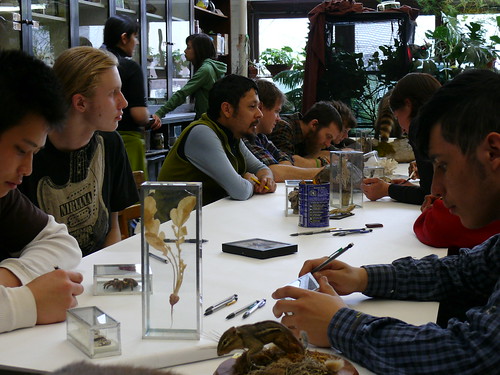
Edna Lawrence Nature Lab, was established in 1937 also as a resource for students. Instead of works of art, the Nature Lab offers taxidermy specimens, bones, seed pods, and other natural items. Both buildings are located within whispering distance of one another at the heart of the city-scattered campus. Both are free for students. Both consider themselves museums with curators, a collection, and a similar mission. And yet, the Museum of Art is often overlooked or dismissed outright by students and the Nature Lab is cherished and spoken of fondly.
It was always obvious to me which was the preferred resource. I worked in the Museum of Art for my four years at RISD and when I'd talk about my tour-guide job there, other students would say, "Oh yeah, I never go there," or sometimes they'd say, "I should go there sometime," but I never heard the Museum referred to with the same glassy-eyed endearment that the Nature Lab enjoyed. Lack of appreciation for the Museum became even more apparent when it was announced that the Museum would be undergoing a massive renovation and addition. Students talked about the new plans with disgust, insulted that the money was going to the Museum instead of their studios. Regardless of the fact that the grant was specifically for the Museum and the school did not have the choice of funding studio space instead, clearly students didn't see the expansion as benefiting them.
The Museum tries to engage students with various programs and exhibitions, some

more successful than others. The Sitings contest invites students to propose an installation and the two proposals that win each year are awarded grants and displayed in the Museum. Faculty shows tempt students into the Museum to see the work of their professors. The Siskind Center gives students the opportunity to pore over the Museum's massive collection of works on paper. Evening events entice with the promise of music and food. And Museum staff pat themselves on the back and think, "Mission accomplished. We've engaged the students." But a quick informal poll suggests otherwise.
The Museum is open the usual 10-5, Tuesday-Sunday, you can't bring in an ink pen without a permit, and the evening events attract mostly older community members instead of students. As much as I loved spending time in the Museum, drawing the sculptures, chatting with the docents, giving my friends informal tours, and enjoying bluegrass music in the painting gallery, I knew that not everyone felt so free in the museum environment. They preferred the cluttered, noisier, dirtier atmosphere of the Nature Lab. To them, the Nature Lab was much more accessible.

While the Nature Lab does admit the general public, the majority of users (as opposed to visitors) are RISD students and the place is nearly always packed. And effortlessly- no programs, no big exhibitions, just old animal skulls and sea shells. The Lab is open late, the staff is almost entirely students, and they sometimes play music on the stereo. You don't have to sign up to use wet media, you can touch many of the specimens, and you can even check some of them out. Some of the display cases contain mini-exhibitions curated by students.
I was one of very few students who worked in the Museum and we were relegated to the roles of tour guide and intern. I would have loved to be a part of a student curator club and make my own exhibitions with works from the Museum's 8,000 piece collection. And a student docent program would provide opportunities for work-study students to interpret the pieces for fellow students and fellow artists. I understand the security issues and archival issues of loosening up the atmosphere and handling the collection more, but what use are those objects if they aren't being used to inspire the students? And who better to care for them than artists who understand the materials and have a tremendous respect the works?
I'd love to see the Museum absorb the Nature Lab or maybe the other way around. A sort of art-museum-meets-natural-history-museum-with-library-component- maybe an Art-Nature-Museum-Lab. I could definitely see myself paying for a membership to enjoy a museum that also provided a unique space for me to come and create my own work. And anyone who has created artwork in public knows that people absolutely love to see artists at work. It reminds visitors that the art they are looking at was created by a human being and it can inspire them to look at natural objects in new ways and maybe feel less intimidated by the art-making process.
I don't think that all art museums need to be Art-Nature-Museum-Labs. There's definitely a place for white-walled museums with quiet, contemplative atmospheres and I'd hate to see places like that disappear. But the RISD Art Museum has missed its mark where its younger, quirkier cousin the Nature Lab has filled a need. The Museum could really benefit from a long hard look at itself and its mission and take a few cues from the time-honored, student-approved tradition around the corner.

Photo credits, top to bottom: RISD Museum of Art, Frank Mullin, Flickr user onerisd, Flickr user newurbanarts


 A week ago I put on my boots and my puffy white shirt and sailed up to the NorCal Pirate Festival, a pirate-themed event at the docks on Mare Island in Vallejo California. There were vendors selling piratey wares, musicians playing sea shanties, games of all kinds, and more pirates than I’d ever seen! Perhaps more pirates than the world has ever seen: the festival has unofficially broken the Guinness record for the largest pirate gathering in history.
 The Governor, far right, awaits his turn to sign my pardon.
 nger pirate. A good thing too because Mr. Fairfax informed me that another lady pirate, Anne Bonny, was due to be “given a fair trial and hanged” that very day.


 nd School of Design was established in 1877 alongside its Museum of Art intended as a resource for students. The Museum hosts collections directly related to the majors offered at the school, including painting, sculpture, and decorative art and design. The Edna Lawrence Nature Lab, was established in 1937 also as a resource for students. Instead of works of art, the Nature Lab offers taxidermy specimens, bones, seed pods, and other natural items. Both buildings are located within whispering distance of one another at the heart of the city-scattered campus. Both are free for students. Both consider themselves museums with curators, a collection, and a similar mission. And yet, the Museum of Art is often overlooked or dismissed outright by students and the Nature Lab is cherished and spoken of fondly.
 more successful than others. The Sitings contest invites students to propose an installation and the two proposals that win each year are awarded grants and displayed in the Museum. Faculty shows tempt students into the Museum to see the work of their professors. The Siskind Center gives students the opportunity to pore over the Museum's massive collection of works on paper. Evening events entice with the promise of music and food. And Museum staff pat themselves on the back and think, "Mission accomplished. We've engaged the students." But a quick informal poll suggests otherwise.
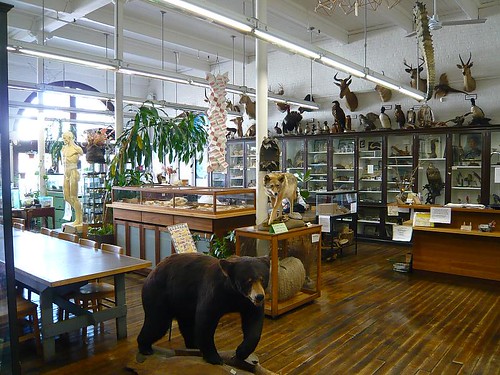 While the Nature Lab does admit the general public, the majority of users (as opposed to visitors) are RISD students and the place is nearly always packed. And effortlessly- no programs, no big exhibitions, just old animal skulls and sea shells. The Lab is open late, the staff is almost entirely students, and they sometimes play music on the stereo. You don't have to sign up to use wet media, you can touch many of the specimens, and you can even check some of them out. Some of the display cases contain mini-exhibitions curated by students.