I have a gift from Country Bumpkin to give away today! Their latest absolutely beautiful calendar (2014). It is full of amazing high resolution pictures of embroideries.
I would like to send it to a lucky reader. Send your Name and Address to me at tricia@alum.mit.edu. Include CALENDAR in the subject line. I will choose one person from the entries I get by Jan 31st, midnight EST to send this to!
Tricia
Selasa, 28 Januari 2014
Minggu, 26 Januari 2014
Auction Results!
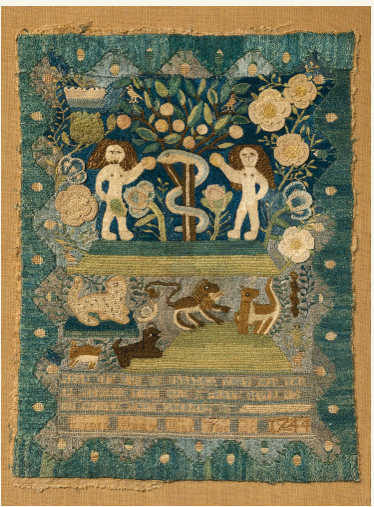
I managed to finally get to NYC Thursday night (Storm Janus caused transportation havoc) for the Winter Antiques Show and Americana auctions at Sotheby's. I am glad I got there as I had the opportunity to see the wonderful folk art as well as one of those amazingly rare samplers that has it all - color, condition, graphic appeal and rarity. I must have stood in front of this piece for almost 20 minutes marveling at it. Ok, I coveted it in a big way! It had been at the American Folk Art Museum as a promised gift of a famous folk art collector who unfortunately is now in jail and his collection was being auctioned to pay debts.
This was a Boston sampler from 1744 and I believe it wasn't exhibited in Pam Parmel's landmark exhibition of Boston Colonial Embroidery at the MFA Boston in 2011. (Read an article by MFA Boston curator Pam Parmel on the exhibit here with lots of pictures). It's cousins were, and so the style was well known to me. This piece out shown them all as the silk amazingly was the same color it was when stitched as well as done so well. Graphically it is really stunning and the inclusion of the detached needlelace flowers is fantastic. Pan Parmel has theorized that these samplers were derived from 17th century samplers that may have been in the possession of the teachers at the time because they do not follow the progression of the early 18th century samplers of the English tradition.
There have been only a handful of embroidered samplers which have sold in the six figures ever. One that was also in this type of condition and worked by the daughter of the man who rowed Paul Revere across from the North Church for his ride was sold a few years ago for this level. Again, it had 'everything going for it'. This piece was estimated at $30,000-$40,000 but it went for $233,000. I would have liked to have been there to hear the buzz yesterday in the auction room. $30,000 now sounds like a bargain. But I am so happy to have seen it, especially as so many of our pieces that survive are devoid of the exuberant color that only little girls could have imagined going together. I just might have to work a piece in these dark and bright colors myself. I love the line up of the animals in the garden of eden, look to the far right and you will see a tiny frog stitched just above a small bird.
Secretly I hope that the MFA Boston was bidding and won this piece so everyone would be able to enjoy it some day, but I doubt that they had the acquisition budget for this level.
Below are the catalog notes from Sotheby's on this piece. You can go to their site and use the zoom function to enjoy the piece and its lovely stitching and color from home. Remember that this piece is only the size of a sheet of paper!
Lydia Hart worked the most visually appealing example within Boston's earliest known group of samplers which presently dates from 1724 to 1754. Nine pieces portray nearly identical figures of Adam and Eve above similar beasts, birds, and bugs. They also include elegant renditions of the Scottish thistle and Tudor rose, signifying the 1603 union of Scotland and England upon the ascension of James I (1566-1625). Lydia's work is the first to have what became a characteristic border for these and later eighteenth-century pastoral samplers, but its solidly worked background is unique. Earlier pieces by Mehetabel Done (1724), Martha Butler (1729), and Abigail Pool (1737) depict Adam and Eve beneath borderless alphabets and band patterns. In 1734 Ann Peartree and Elizabeth Langdon worked nearly identical borderless pictorial samplers with similar motifs on brown linen. More closely related to Lydia's work are samplers by Rebekah Owen (1745), Sarah Lord (1753), and Mary Lord (1754), with the same borders and gardens.2 Rebekah and Mary worked the same inscription as Lydia. Lydia's identity remains uncertain. The Lydia born in Boston to Elias and Lydia Hart on September 12, 1719, is unlikely to have worked this at the age of twenty-four.3Among the nine pieces described, the known ages of six makers range from nine to thirteen years.
This was a Boston sampler from 1744 and I believe it wasn't exhibited in Pam Parmel's landmark exhibition of Boston Colonial Embroidery at the MFA Boston in 2011. (Read an article by MFA Boston curator Pam Parmel on the exhibit here with lots of pictures). It's cousins were, and so the style was well known to me. This piece out shown them all as the silk amazingly was the same color it was when stitched as well as done so well. Graphically it is really stunning and the inclusion of the detached needlelace flowers is fantastic. Pan Parmel has theorized that these samplers were derived from 17th century samplers that may have been in the possession of the teachers at the time because they do not follow the progression of the early 18th century samplers of the English tradition.
There have been only a handful of embroidered samplers which have sold in the six figures ever. One that was also in this type of condition and worked by the daughter of the man who rowed Paul Revere across from the North Church for his ride was sold a few years ago for this level. Again, it had 'everything going for it'. This piece was estimated at $30,000-$40,000 but it went for $233,000. I would have liked to have been there to hear the buzz yesterday in the auction room. $30,000 now sounds like a bargain. But I am so happy to have seen it, especially as so many of our pieces that survive are devoid of the exuberant color that only little girls could have imagined going together. I just might have to work a piece in these dark and bright colors myself. I love the line up of the animals in the garden of eden, look to the far right and you will see a tiny frog stitched just above a small bird.
Secretly I hope that the MFA Boston was bidding and won this piece so everyone would be able to enjoy it some day, but I doubt that they had the acquisition budget for this level.
Below are the catalog notes from Sotheby's on this piece. You can go to their site and use the zoom function to enjoy the piece and its lovely stitching and color from home. Remember that this piece is only the size of a sheet of paper!
Lydia Hart worked the most visually appealing example within Boston's earliest known group of samplers which presently dates from 1724 to 1754. Nine pieces portray nearly identical figures of Adam and Eve above similar beasts, birds, and bugs. They also include elegant renditions of the Scottish thistle and Tudor rose, signifying the 1603 union of Scotland and England upon the ascension of James I (1566-1625). Lydia's work is the first to have what became a characteristic border for these and later eighteenth-century pastoral samplers, but its solidly worked background is unique. Earlier pieces by Mehetabel Done (1724), Martha Butler (1729), and Abigail Pool (1737) depict Adam and Eve beneath borderless alphabets and band patterns. In 1734 Ann Peartree and Elizabeth Langdon worked nearly identical borderless pictorial samplers with similar motifs on brown linen. More closely related to Lydia's work are samplers by Rebekah Owen (1745), Sarah Lord (1753), and Mary Lord (1754), with the same borders and gardens.2 Rebekah and Mary worked the same inscription as Lydia. Lydia's identity remains uncertain. The Lydia born in Boston to Elias and Lydia Hart on September 12, 1719, is unlikely to have worked this at the age of twenty-four.3Among the nine pieces described, the known ages of six makers range from nine to thirteen years.
A Lydia of appropriate age was born in Northington, Connecticut, to Joseph and Mary Bird Hart on August 8, 1728. Her father was a shoemaker, deacon of the church, and a town magistrate.4 Quite possibly his daughters were educated in Boston. This Lydia married Noah Gillet (1718-1790) on December 15, 1748, and their ten children were born in Farmington, Connecticut.5 No woman is known to have kept a Boston girls' school from 1724 through 1754, but circumstantial evidence suggests that these samplers may have been worked under the instruction of Susanna Hiller Condy (1686-1747) and her sister-in-law Abigail Stevens Hiller (?-1775), who advertised her school from February 1748 until May 1756.6 Four samplers dated 1765 to c. 1772 have Lydia's border and similarly worked flowers, including one by Mary Welsh, whose sister Hannah married Abigail's son Joseph (1721-1758).7 -B.R.
1 For five of the nine samplers mentioned here, another closely related example, and the best known English prototype, see Ring, Girlhood Embroidery, vol. 1, pp. 37-41, figs. 33-370 39, and the catalog for Sotheby's sale 7010 (6/97, lots 330, 331, 332).
2 This was probably the Lydia Hart who worked a borderless band sampler inscribed "Boston" and dated "February The 4 Day 1731" (collection New Hampshire Historical Society, Concord).
3 Alfred Andrews, Genealogical History of Deacon Stephen Hart and His Descendants, 1632-1875 (Hartford, Conn.: Case, Lockwood, and Brainard, 1875), pp. 169, 181.
4 Wilma Gillet Thomas, The Joseph Gillet/Gillett/Gillette Family of Connecticut, Ohio, and Kansas (Chicago, Ill.: Adams Press, 1970), p. 32.
5 Boston Evening-Post (Feb. 1, 1748, April 22, 1751, and April 9, 1753), and Boston Gazette (June 11, 1754, May 26, 1755, and May 24, 1756).
6 Stephen Huber and Carol Huber, The Sampler Engagement Calendar 1992 (Old Saybrook, Conn.: 1991), fig. 45, Calendar 1993, fig. 38, Elisabeth Donaghy Garren, "American Samplers and Needlework Pictures in the DAR Museum, Part I: 1739-1806," The Magazine Antiques 105, no. 2 (February 1974): 358, and Ring, Girlhood Embroidery, vol. 1, p. 53, fig. 51.
7 Helen Bowen, “The Fishing Lady and Boston Common,” Antiques 4, no. 2 (August 1923): 70-73.
Sabtu, 25 Januari 2014
Does that Star-Spangled Banner Yet Wave
Checking in on Sheriff Joe:
A diet of bread and water is the punishment for dozens of Arizona inmates who allegedly defaced American flags placed in their jail cells.Piping in patriotic songs and hanging flags in a notoriously abusive prison and then punishing the inmates with bread and water when they don't show adequate appreciation. It'd be difficult to make-up a better Orwellian America mash-up.
[...]
"These inmates have destroyed the American flag that was placed in their cells," Arpaio said. "Tearing them, writing on them, stepping on them, throwing them in the toilet, trash or wherever they feel. It's a disgrace ... this is government property that they are destroying, and we will take action against those who act this way."
The flags are part of a push for patriotism in county jail cells that includes listening to the "Star-Spangled Banner" every morning and "God Bless America" every night over the intercom system.
Kamis, 23 Januari 2014
JANUARY & FEBRUARY @ GALLERY NORTH: Rebels, Hipsters and Visionaries, Bay Area Poets and Artists, 1950s and 60s
OPENING RECEPTION: Friday, January 10, 5:30 - 8:30pm
Zan Stewart on Jazz Saxophone. Refreshments.
Firehouse Gallery North is located on 1790 Shattuck Avenue, North Berkeley, CA 94709
January Events
Monday, Jan. 13, 7:30 - 9:45 pmBeat/SF Renaissance author & poet David Meltzer’s seminar on the Beat Era: Beat Things - Using as a starting point, Beat Thing: La Alameda Press, 2004, a contextualization of that cultural moment's history. Both personal and critical, Meltzer offers a look at problematizing mythopoetic versions invented by successive generations. $20 at the door/Info:julmind@mtashland.net
Saturday, Jan. 18, 7 – 8 pm
Screening of 'San Francisco's Wild History Groove' by Mary Kerr. $5.
Friday Jan. 24, 7 m
Friday Jan. 24, 7 m
Screening of 'Howl', directed by Rob Epstein and Jeffrey Friedman and starring James Franco. $5
Monday, Jan. 27, 7:30 - 9:45 pm
Beat/SF Renaissance author & poet David Meltzer’s seminar on the LA Avant Garde Scene & Wallace Berman: an exploration of Berman's utilization of kabbalistic ideas and symbols in his variegated body of art works. $20 at the door/Info:julmind@mtashland.net
Friday, February 7, 7 -8:30pm
Saturday, February 15, 7 - 9 pm
Posted by: Julia Lazar
Quick, post that comment, before the thought disappears. You know we love to hear from you.
February events
Saturday, February 1, 2 – 4 pmPoetry Reading with Jack Hirschman and David Meltzer - $10
Friday, February 7, 7 -8:30pm
Screening of 'Venice West and the LA Scene' by Mary Kerr. David Reid host discussion. $5
Saturday, February 15, 7 - 9 pm
The Zan Stewart Band with pianist Keith Saunders, bassist Adam Guy, and drummer Ron Marabuto, $7 - 10 at the door.
![]() |
| OPENING NIGHT, JANUARY 10, 2014 |
Posted by: Julia Lazar
Quick, post that comment, before the thought disappears. You know we love to hear from you.
Lego Robots + Textiles = WOW
So the robot guys are relaxing and they were searching cool mechanical things to do with the Lego robot parts and found these two looms made from legos. Yes - working LOOMS with legos. One is mechanical and the other is a programmed loom. Crazy cool. I told them I wanted them to weave me something. Go to the sites and watch the videos. Totally crazy cool.
Tricia
Tricia
Rabu, 22 Januari 2014
Friendly Rivalry
Without a doubt, the most important thing about this story is that JDate and Christian Mingle collaborate on an annual survey.
Also, Jews are less likely to cheat. So that's good.
David Hirsh's 101 Lesson on Opposing BDS
David Hirsh, in a masterful post gets all the key points of the anti-racist and counter-anti-Semitic movement against the BDS in one place. This is a necessary resource (Engage is already a necessary resource, but this post is an absolutely invaluable compilation).
Selasa, 21 Januari 2014
The Wheel Never Stops Turning
Ta-Nehisi Coates writes:
I'm reminded of the post I wrote about Judge A. Leon Higginbotham's opinion declining to recuse himself in an employment discrimination suit (Local Union 542, Int'l Union of Operating Eng'rs, 388 F. Supp. 155 (E.D. Pa. 1974)). Judge Higginbotham was black and a known civil rights advocate, and therefore, according to the defendants, biased. One of the examples Judge Higginbotham cited in declining to recuse himself was his Jewish colleagues:
And on the flipside, why do we see the same rhetorical tropes used to silence Jews and Blacks alike, in seemingly such different contexts? Well why wouldn't we? If a given tactic for maintaining a particular hierarchy has worked for one group, why wouldn't it be adopted and utilized by others trying to preserve different hierarchies? The issue here isn't that all oppressions are fundamentally the same, or any such trite nonsense. But oppression is, after all, ultimately about results. Racists take their cues on what has worked for anti-Semites, and vice versa. The prevalence of rhetoric that asserts Jews shouldn't speak on Jewish issues, versus that Blacks shouldn't speak on Black issues, depends primarily on (a) the relative well-being of the groups in question and (b) what community of speakers you're dealing with.
From time to time, someone will ask why I write so much about racism. The underlying charge is that a writer should cease to follow his curiosities. I might well retort that Paul Krugman should stop writing about the economy, or Jeff Goldberg should stop writing about the Middle East. The difference is that the world which racism made is seen as a niche issue, with no real import. "Gender" and "women's issues" are often regarded in the same way.And I thought that was strange, because of course plenty of people do say Jeff Goldberg should stop writing about the Middle East -- less because it is viewed as a "niche" issue and more because Goldberg is viewed as a niche person. Specifically, it is often argued that -- as a Jew with substantial ties to Israel -- Goldberg is biased, that he should leave the discussion to neutral, non-partisan gentile hands.
I'm reminded of the post I wrote about Judge A. Leon Higginbotham's opinion declining to recuse himself in an employment discrimination suit (Local Union 542, Int'l Union of Operating Eng'rs, 388 F. Supp. 155 (E.D. Pa. 1974)). Judge Higginbotham was black and a known civil rights advocate, and therefore, according to the defendants, biased. One of the examples Judge Higginbotham cited in declining to recuse himself was his Jewish colleagues:
I am pleased to see that my distinguished colleagues on the bench who are Jewish serve on committees of the Jewish Community Relations Council, on the boards of Jewish publications, and are active in other affairs of the Jewish community. I respect them, for they recognize that the American experience has often been marred by pervasive anti-Semitism. I would think less of them if they felt that they had to repudiate their heritage in order to be impartial judges. (180)My post, of course, turned the full circle -- in response to people who do say that Jews should not speak or should not be in positions of authority on matters relating to Jewish interests -- I used Judge Higginbotham's powerful opinion as a counterpoint. Higginbotham uses the example of Jews to help Blacks, I use the example of Blacks to help Jews. There's no jealousy, only an example that can help check a common foe.
And on the flipside, why do we see the same rhetorical tropes used to silence Jews and Blacks alike, in seemingly such different contexts? Well why wouldn't we? If a given tactic for maintaining a particular hierarchy has worked for one group, why wouldn't it be adopted and utilized by others trying to preserve different hierarchies? The issue here isn't that all oppressions are fundamentally the same, or any such trite nonsense. But oppression is, after all, ultimately about results. Racists take their cues on what has worked for anti-Semites, and vice versa. The prevalence of rhetoric that asserts Jews shouldn't speak on Jewish issues, versus that Blacks shouldn't speak on Black issues, depends primarily on (a) the relative well-being of the groups in question and (b) what community of speakers you're dealing with.
What's in Your Local Museum?
![]() |
| Sarah Marie Jacques, 1820 Milwaukee Public Museum |
Maybe you can check out what is local to you and help the Archive project locate more pieces! The downloadable form is on their website under downloads. While you are at it, duplicate your report and sent it to the Colonial Dames. They were behind the publication of American Samplers by Bolton and Coe in the early part of the last century. That tome is still used today by historians to find samplers and names for regions. It has limited pictures and it is a struggle to find out where the sampler is now, but knowing that a girl of a particular family did one is a great help when trying to piece together history.
Big Love
I had the pure pleasure last year of making wedding rings for two of the best sorts who got hitched in late December...
Congratulations again to you sweethearts!
Sabtu, 18 Januari 2014
UNESCO Cancels(?) Jews in Israel Exhibit
Repeat after me: The UN is a neutral organization which is not remotely hostile to Jews qua Jews:
UPDATE: UNESCO's statement is here.
UPDATE 2x: It now appears that the exhibit will open in June after a six month delay.
The Obama administration is “deeply disappointed” with a decision by UNESCO, the United Nation’s cultural arm, to cancel the opening of an exhibition on the Jewish presence in the land of Israel and is seeking its placement “as soon as possible.”One can almost see the crocodile from which the Arab League's tears emerge:
Complaints by Arab states led UNESCO to cancel the exhibition, organized by the Simon Wiesenthal Center along with the governments of Canada and Montenegro. It was scheduled to open Jan. 20 at the Paris headquarters of the United Nations Educational, Scientific and Cultural Organization.
“The United States is deeply disappointed and has engaged with senior levels at UNESCO to confirm that the action to postpone does not represent a cancellation and to underscore our interest in seeing the exhibit proceed as soon as possible,” a State Department official said, speaking on customary anonymity. “We trust that UNESCO will approach this issue fairly and in a manner consistent with the organization’s guidelines and past precedent.”
UNESCO director-general Irina Bokova said Wednesday in a letter to the Simon Wiesenthal Center that the exhibit, titled “The People, the Book, the Land — 3,500 years of ties between the Jewish people and the Land of Israel,” would be postponed indefinitely. She said the decision arose out of UNESCO’s support for peace talks between Israel and the Palestinian Authority.
The cancellation followed a letter sent to Bokova on Jan. 14 by the Arab group at UNESCO. “The Arab group is deeply disturbed by the exhibition, which it condemns,” said the letter from the group’s president, Abdullah Elmealmi.If peace talks are so fragile such that acknowledging Jews have a connection to Israel will damage them, surely we are doomed. Though I suppose that all depends on what terms one expects "peace" to occur on.
“This cause is championed by those who oppose peace efforts,” Elmealmi said. “The media campaign accompanying the exhibition will inevitably damage the peace talks, the incessant efforts of U.S. Secretary of State John Kerry and UNESCO’s neutrality.”
UPDATE: UNESCO's statement is here.
UPDATE 2x: It now appears that the exhibit will open in June after a six month delay.
Second Act by the Oedels- Artisans of Antiquity
One of the most challenging parts of getting the Cabinet of Curiosities course off the ground was the decade of searching for the right people to work with. The people had to CARE about the subject as much as I did and be willing to put in the extra mile for historic integrity. I want to introduce to you the couple who were the keystones in this venture, Richard and Marie Oedel.
Our meeting was entirely chance. Marie had heard about the Plimoth Jacket from a friend and was studying embroidered bindings of the 17th century as an interest and wanted to talk. I had suspicions that bookbinding was very important in the caskets and so instead of just answering her email, I did some web searching and found a phone number. The rest became history!
Marie and Richard both had highly successful careers in different fields before they decided to make a radical change and become craftsmen, going back to school to do so. We all share this career history and apply our knowledge to our new fields.
Marie has figured out how to cover the boxes and guided me through all the complications of glues, papers, and suppliers as well as investigated historic caskets with me. Richard is our cabinet maker. That seems such as simple statement but it isn't -- co-researcher is more like it. The things I have learned about cabinet making (today and yesterday) informs the interpretation of what we see on the historic objects. It has been great fun working with these consummate professionals!
I have been asked by many of the students in the class to profile the artisans and so I have started with the Oedels. I think that the best way to profile them is to point you to a wonderful article on them and their 'second act' by their alma matter University of New Hampshire.
Our meeting was entirely chance. Marie had heard about the Plimoth Jacket from a friend and was studying embroidered bindings of the 17th century as an interest and wanted to talk. I had suspicions that bookbinding was very important in the caskets and so instead of just answering her email, I did some web searching and found a phone number. The rest became history!
Marie and Richard both had highly successful careers in different fields before they decided to make a radical change and become craftsmen, going back to school to do so. We all share this career history and apply our knowledge to our new fields.
Marie has figured out how to cover the boxes and guided me through all the complications of glues, papers, and suppliers as well as investigated historic caskets with me. Richard is our cabinet maker. That seems such as simple statement but it isn't -- co-researcher is more like it. The things I have learned about cabinet making (today and yesterday) informs the interpretation of what we see on the historic objects. It has been great fun working with these consummate professionals!
I have been asked by many of the students in the class to profile the artisans and so I have started with the Oedels. I think that the best way to profile them is to point you to a wonderful article on them and their 'second act' by their alma matter University of New Hampshire.
Jumat, 17 Januari 2014
... That Magical Time of Year When a Worker's Thoughts Turn To Love
Various permutations of this essay by Miya Tokumitsu, which attacks the concept of "Doing What You Love" (DWYL), has been making the blogospheric rounds to much applause. Allow me to dissent. Tokumitsu does not do nearly enough to demonstrate a causal link between the DWYL mentality and erasure of the lives of working class. Indeed, if anything DWYL is a valuable contributor to our understanding of "work", including for the "non-creative" working class.
Summarizing and simplifying, Tokumitsu observes that there only certain classes of jobs, typically held by certain classes of people, which are even candidates to be a job one might "love". The vast majority of jobs, including jobs necessary for the maintenance of "loved" jobs, are not going to be particularly fun or intellectually stimulating no matter what we do. Therefore, DWYL is inherently classist: "labor that is done out of motives or needs other than love--which is, in fact, most labor--is erased." Meanwhile, DWYL encourages exploitation -- it is basically a way to make workers content with getting less in the way of tangible proceeds in favor of nebulous emotional satisfaction.
As someone who has in the past few years done both a job that I loved (in the classic DWYL form), and a job that, we shall say, does not fit into that category, I feel well-positioned to discuss this issue. And given that the latter job paid triple the former (loved) one, I can even speak to the trade-off between tangible and intangible job benefits.
But let's not start with me; let's start instead with the claim that DWYL is class-divisive and "erases" workers whose jobs are not candidates to be loved. Put bluntly, I'm skeptical that the wealthy need the aid of a mantra to forget about the life and working conditions of the lower classes. That's really more of the default setting. The alternative to caring about how workers feel about their jobs emotionally is not necessarily caring about what workers get out of their jobs tangibly -- it can very easily be (and historically has been) caring about neither. A similar critique can be leveled at her claim that if someone does not obtain profit from pursuing their passion, DWYL implies that the fault must be in their enthusiasm. While I've never actually heard that assertion made, I admit I'm never surprised at the capacity of some people to attribute any deficiency in the lives of the working class to their own deficiencies. Suffice to say, this tendency predates DWYL, it is not caused by it.
What DWYL recognizes is that the tangible products of a job are not sufficient to provide for fulfilling lives. One can be tangibly provided for at market rates and still not have "enough". In other words, DWYL is in many respects a (admittedly inchoate) statement about a substantive entitlements -- that we are not owed just whatever dollar amount our employer puts in our pocket, but some level of happiness, dignity, and respect out of our job. Those values should be included in our calculus of what workers are provided.
Indeed, some of her treatment of improved intangible working conditions strikes me as almost incomprehensible. She quotes Marc Bousquet as saying that the "loved" academic job environment actually presents a model for corporations:
Reading the above, one would think that the way a corporation makes people love what they do is by casting an incantation or spiking the cafeteria with hallucinogenic drugs. In reality, to make workers happy by means other than a pay raise, one has to do things that make workers happier with their jobs. Those are real benefits, not chimeras -- I'd take my less-paying but more loved job over my less-loved, better paying counterpart in a heartbeat. The trade-off isn't infinite, of course, but all that demonstrates is that neither the tangible nor intangible proceeds of work are sufficient for self-fulfillment.
Which cycles us back to those workers whose jobs are not and cannot be made loveable. We should say here that almost any job can be made, if not loveable, than at least more likeable -- by being treated fairly and with respect, for instance, or by having some security such that one isn't not in constant dread of being tossed on the street. But even to the extent these jobs lie beyond true DWYL, the concept still matters because it provides a contrast to the prevailing counternarrative -- "the value of a honest day's work." That mantra, which by my lights is far more likely to represent the real competitor to DWYL (as compared to some sort of cross-class solidarity pressing for higher salaries for everyone), cares neither whether the worker is happy or whether they getting significant tangible returns -- value comes from working whatever job the market provides at whatever rate the market pays. I'm reminded of the archetypical 50s parent who, upon hearing that his son isn't happy at work, bellows that "You hate your job? I hated my job too! That's the point of a job!"
DWYL recognizes, at the very least, that the emotional side is important -- and anytime the American cultural zeitgeist recognizes any form of substantive entitlement as necessary for a fulfilled life, I'm inclined to jump on it. And to the extent we do view DWYL as a form of substantive entitlement and we simultaneously reckon with the fact that certain people are not (and likely cannot get it), that does provide a fulcrum from which those people can leverage a claim for greater tangible benefits as compensation. Of course, I'm not saying it's a guarantee that thinking about DWYL will cause wealthier Americans to recognize the deprivations faced by their working class peers -- as I said, wealthy Americans hardly need any excuse to ignore others outside their class. But attribute the lack of cross-class consciousness to DWYL is difficult to justify. .
The bottom line is that the notion that we can view work solely through the lens of the monetary returns workers get doesn't cohere to how people of any class actually view their work. We don't just want "fulfillment" or "respect", but we don't just want a dollar figure either. It's obviously true that if one is being paid little, the marginal value of each additional dollar is going to be higher compared to additional "respect" or whatnot. But that doesn't change the fact that thinking about work in a way that's helpful to workers requires a holistic approach. DWYL matters because it is a recognition about what workers are owed, and any sort of public understanding of the proceeds of work that starts from what workers deserve, rather than what the market deigns to give them, is in my book a good thing
Summarizing and simplifying, Tokumitsu observes that there only certain classes of jobs, typically held by certain classes of people, which are even candidates to be a job one might "love". The vast majority of jobs, including jobs necessary for the maintenance of "loved" jobs, are not going to be particularly fun or intellectually stimulating no matter what we do. Therefore, DWYL is inherently classist: "labor that is done out of motives or needs other than love--which is, in fact, most labor--is erased." Meanwhile, DWYL encourages exploitation -- it is basically a way to make workers content with getting less in the way of tangible proceeds in favor of nebulous emotional satisfaction.
As someone who has in the past few years done both a job that I loved (in the classic DWYL form), and a job that, we shall say, does not fit into that category, I feel well-positioned to discuss this issue. And given that the latter job paid triple the former (loved) one, I can even speak to the trade-off between tangible and intangible job benefits.
But let's not start with me; let's start instead with the claim that DWYL is class-divisive and "erases" workers whose jobs are not candidates to be loved. Put bluntly, I'm skeptical that the wealthy need the aid of a mantra to forget about the life and working conditions of the lower classes. That's really more of the default setting. The alternative to caring about how workers feel about their jobs emotionally is not necessarily caring about what workers get out of their jobs tangibly -- it can very easily be (and historically has been) caring about neither. A similar critique can be leveled at her claim that if someone does not obtain profit from pursuing their passion, DWYL implies that the fault must be in their enthusiasm. While I've never actually heard that assertion made, I admit I'm never surprised at the capacity of some people to attribute any deficiency in the lives of the working class to their own deficiencies. Suffice to say, this tendency predates DWYL, it is not caused by it.
What DWYL recognizes is that the tangible products of a job are not sufficient to provide for fulfilling lives. One can be tangibly provided for at market rates and still not have "enough". In other words, DWYL is in many respects a (admittedly inchoate) statement about a substantive entitlements -- that we are not owed just whatever dollar amount our employer puts in our pocket, but some level of happiness, dignity, and respect out of our job. Those values should be included in our calculus of what workers are provided.
Indeed, some of her treatment of improved intangible working conditions strikes me as almost incomprehensible. She quotes Marc Bousquet as saying that the "loved" academic job environment actually presents a model for corporations:
How to emulate the academic workplace and get people to work at a high level of intellectual and emotional intensity for fifty or sixty hours a week for bartenders’ wages or less? Is there any way we can get our employees to swoon over their desks, murmuring “I love what I do” in response to greater workloads and smaller paychecks? How can we get our workers to be like faculty and deny that they work at all? How can we adjust our corporate culture to resemble campus culture, so that our workforce will fall in love with their work too?From this analysis, she concludes "Nothing makes exploitation go down easier than convincing workers that they are doing what they love."
Reading the above, one would think that the way a corporation makes people love what they do is by casting an incantation or spiking the cafeteria with hallucinogenic drugs. In reality, to make workers happy by means other than a pay raise, one has to do things that make workers happier with their jobs. Those are real benefits, not chimeras -- I'd take my less-paying but more loved job over my less-loved, better paying counterpart in a heartbeat. The trade-off isn't infinite, of course, but all that demonstrates is that neither the tangible nor intangible proceeds of work are sufficient for self-fulfillment.
Which cycles us back to those workers whose jobs are not and cannot be made loveable. We should say here that almost any job can be made, if not loveable, than at least more likeable -- by being treated fairly and with respect, for instance, or by having some security such that one isn't not in constant dread of being tossed on the street. But even to the extent these jobs lie beyond true DWYL, the concept still matters because it provides a contrast to the prevailing counternarrative -- "the value of a honest day's work." That mantra, which by my lights is far more likely to represent the real competitor to DWYL (as compared to some sort of cross-class solidarity pressing for higher salaries for everyone), cares neither whether the worker is happy or whether they getting significant tangible returns -- value comes from working whatever job the market provides at whatever rate the market pays. I'm reminded of the archetypical 50s parent who, upon hearing that his son isn't happy at work, bellows that "You hate your job? I hated my job too! That's the point of a job!"
DWYL recognizes, at the very least, that the emotional side is important -- and anytime the American cultural zeitgeist recognizes any form of substantive entitlement as necessary for a fulfilled life, I'm inclined to jump on it. And to the extent we do view DWYL as a form of substantive entitlement and we simultaneously reckon with the fact that certain people are not (and likely cannot get it), that does provide a fulcrum from which those people can leverage a claim for greater tangible benefits as compensation. Of course, I'm not saying it's a guarantee that thinking about DWYL will cause wealthier Americans to recognize the deprivations faced by their working class peers -- as I said, wealthy Americans hardly need any excuse to ignore others outside their class. But attribute the lack of cross-class consciousness to DWYL is difficult to justify. .
The bottom line is that the notion that we can view work solely through the lens of the monetary returns workers get doesn't cohere to how people of any class actually view their work. We don't just want "fulfillment" or "respect", but we don't just want a dollar figure either. It's obviously true that if one is being paid little, the marginal value of each additional dollar is going to be higher compared to additional "respect" or whatnot. But that doesn't change the fact that thinking about work in a way that's helpful to workers requires a holistic approach. DWYL matters because it is a recognition about what workers are owed, and any sort of public understanding of the proceeds of work that starts from what workers deserve, rather than what the market deigns to give them, is in my book a good thing
The Seven Virtues?
![]() |
| Lot 377 Oak Interiors Bonhams January 2014 |
Where are Justice, Hope and Charity in this scene? We have an angel in the middle with a horn in one hand blowing out a horn in the other. And a woman with a bird on her hand holding palm leaves. The palm leaves on women in 17th century embroidery often signify Victory or Peace. Could this be a substitute for hope with the bird on her hand (usually bent pecking the hand if for Touch) represent charity? I could see the angel calling for Justice in the way that justice for the soul on the last day.
This piece is still a bit of a conundrum. Maybe there is a scholar of allegories out there that would like to weigh in.
Kamis, 16 Januari 2014
Rebecca at the Well
![]() |
| Lot 409 Bonhams January 2014 Oak Interiors Sale |
In the case of this piece, being sold by Bonhams this month, it was obviously a panel for or removed from a casket. The frieze (lid?) which was below this (I think a front) is place below in the frame. The scene where Rebecca gives Eliezer the water from the well is most often found on top as it is the climax of the storyline but sometimes shows up as the front.
Rabu, 15 Januari 2014
Elephants in 17th century embroidery
![]() |
| Lot 384 Bonhams January 2014 The Oak Interiors |
This embroidery at Bonhams latest auction made me stop as I thought immediately 'I've seen this before!'. Well I kinda had, but not exactly. There is a piece at the Burrell that is very similar to this and obviously related by teacher or workshop. The piece at the Burrell also has this fun stuffed elephant as well. The item can be seen here and magnified. It is a neat mix of counted embroidery, lots of queen stitch as well as slips and needlelace stuffed to enhance motifs. I like the graphic quality of this piece's coloring and chunky style, a bit modern.
Selasa, 14 Januari 2014
Lesbian Filipina Caregiver wins Israel's "X-Factor"
Pinkwashing! Brownwashing! Poorwashing! Songwashing! Every form of washing imaginable:
Rose Fostanes, a diminutive 47-year-old Filipina caregiver, has emerged as the newest star of Israeli reality television, winning the singing competition “X-Factor Israel” on Tuesday and establishing herself as something of a national phenomenon.Obviously, I support anyone who picks "Sweet Dreams" as part of their finals run.
"
In an upset victory, Fostanes beat out three other finalists by performing crowd-pleasing renditions of Frank Sinatra’s "My Way," Alicia Keys' "If I Ain't Got You," and "Sweet Dreams" by the Eurythmics.
Fostanes arrived in Israel six years ago to work as a caregiver so, like millions of other Filipino workers around the world, she could send money back home to her family and her girlfriend.
To Take a Totally Random Example
Say what you will about the D.C. Circuit's net neutrality decision, but I can't get too upset at any decision that illustrates how the internet works by referencing the hypothetical journey of "a video of a cat" from YouTube to the discerning internet consuemr ("who then views and hopefully enjoys the cat.").
Also quotable: "After all, even a federal agency is entitled to a little pride."
Phew - My UFOs could be worth something?!
![]() |
| Lot 387 Bonhams January 2014 The Oak Interiors |
This tent stitch piece is of the Queen of Sheba visiting King Solomon. The figures and tent would have looked great done in stumpwork! Maybe she was planning that and got a bit flummoxed at the thought!
Senin, 13 Januari 2014
"I Decide"
Ta-Nehisi Coates quotes Frederick Douglass' wife:
At the end of it all, as Coates says, these "isms" are about power. Power is rarely so directionless as to necessitate the slaughter or enslavement of every member of the outgroup. It can maintain its "good Jews" or its "model minorities". After all, even the most bigoted can Have Black Friends. Depending on what one wants to do, one can either define the favored Jew (or whomever) as an exceptional falsehood, or as the only authentic Jew. Though seemingly opposite, the two moves have much the same effect -- to announce that the bulk of the Jewish community is lesser and subhuman, worthy of the scorn and prejudice heaped among them. Those few, special few who are allowed to escape (in part) its grasp are not taken to disprove the prejudice but to confirm it.
It is easy to say, as has been carelessly said by some in commentingIn parallel, he notes the ideology of German anti-Semites when encountering a Jew whom, for whatever reason, they liked: "I decide who is a Jew." Marcus Garvey made a similar observation, stating that "whenever Blacks do anything useful, they are no longer Blacks."
upon Mr. Douglass' life and career, that the intellectual power, the ambition, the talent which he displayed, were inheritances from his white father; that the colored strain disappeared except as it gave the hue to his skin; and that to all intents and purposes Frederick Douglass was a white man.
At the end of it all, as Coates says, these "isms" are about power. Power is rarely so directionless as to necessitate the slaughter or enslavement of every member of the outgroup. It can maintain its "good Jews" or its "model minorities". After all, even the most bigoted can Have Black Friends. Depending on what one wants to do, one can either define the favored Jew (or whomever) as an exceptional falsehood, or as the only authentic Jew. Though seemingly opposite, the two moves have much the same effect -- to announce that the bulk of the Jewish community is lesser and subhuman, worthy of the scorn and prejudice heaped among them. Those few, special few who are allowed to escape (in part) its grasp are not taken to disprove the prejudice but to confirm it.
Langganan:
Postingan (Atom)


